Quick reference
| Question | What to expect |
|---|---|
| Which projections are confirmed? | AP, PA, AP unilateral, posterior axillary, and anterior axillary rib views. |
| Can users try other projections? | Yes. These are confirmed examples. Other projections may be possible when the simulated setup supports them. |
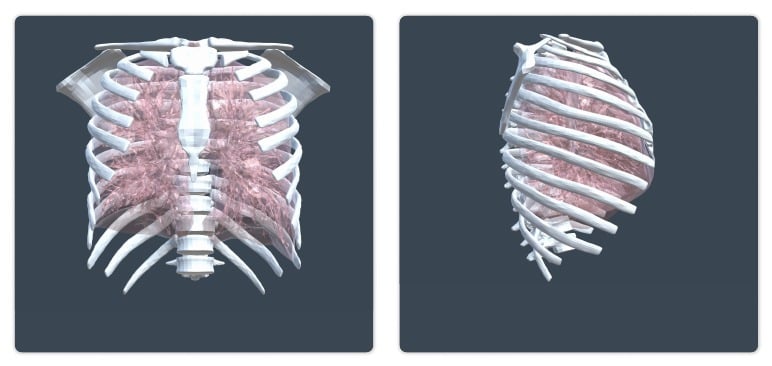
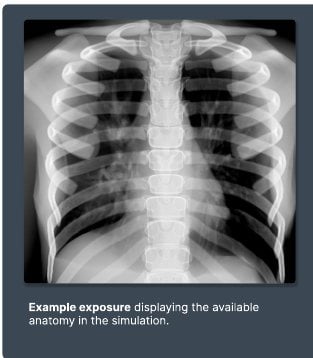
| What anatomy is included? | Thoracic vertebrae, scapulae, clavicles, ribs 1-10, sternum, upper lumbar spine, and lower cervical spine. |
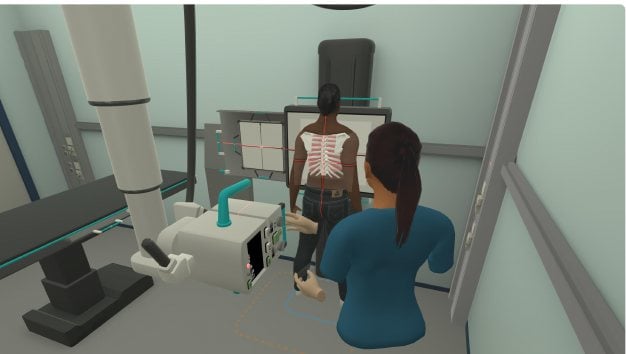
| What setup is used? | Wall bucky workflow. |
| What movement is included? | The rib phantom does not feature joint mobility, but it can be picked up and repositioned. |
| What bone variations exist? | Healthy bone version. |
| Known limitation | Low trabecular bone detail and no inspiration or expiration simulation. |
Visual examples
- Simulator setup
- Bone model
- Example exposure
Imaging capabilities
| Capability | Details |
|---|---|
| Radiographic tube | Full range of motion, including vertical, horizontal, tilt, and rotation. The cassette can be rotated, and collimation size is adjustable. |
| Detector methods | The detector is set up for use with wall bucky. |
| Simulated exposures | Confirmed support for AP, PA, AP unilateral, posterior axillary, and anterior axillary views. Additional views may be possible depending on patient range of motion and available bones. |
Anatomy and movement
| Area | Details |
|---|---|
| Included anatomy | Thoracic vertebrae, scapulae, clavicles, ribs 1-10 bilateral, sternum, upper lumbar spine, and lower cervical spine. |
| Joint mobility | The rib phantom does not feature joint mobility, but it can be freely picked up and repositioned as needed. |
Bone variations
- Healthy bone version