Quick reference
Visual examples
- Simulator setup
- Bone model
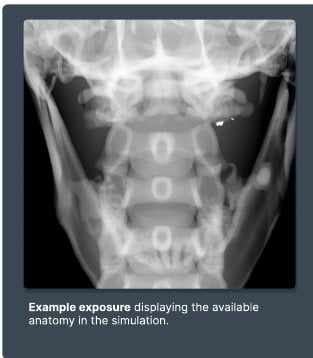
- Example exposure
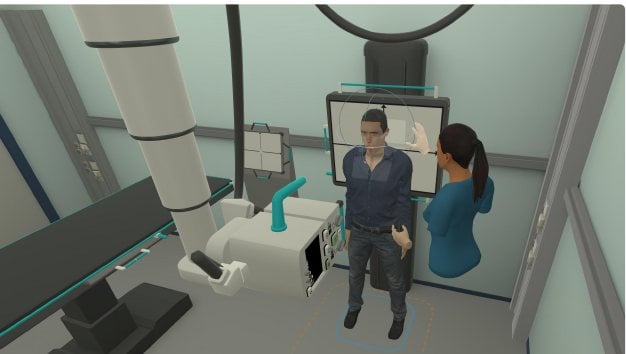
Simulator setup and positioning environment
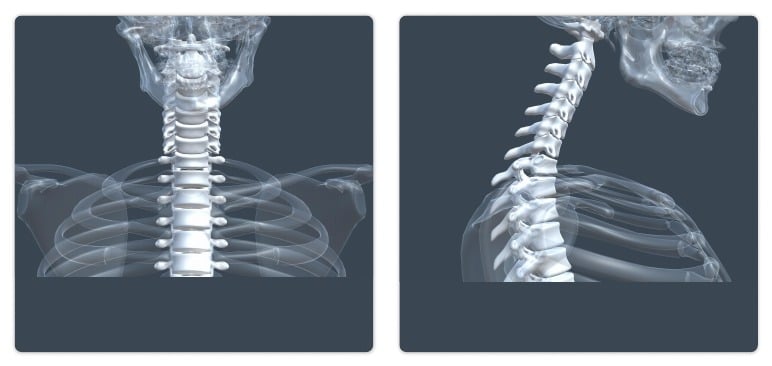
Imaging capabilities
Anatomy and movement
Bone variations
- Healthy bone version
Documentation Index
Fetch the complete documentation index at: /llms.txt
Use this file to discover all available pages before exploring further.
Available anatomy, detector setup, simulated views, bone variations, and known limitations for the cervical spine simulation module.
| Question | What to expect |
|---|---|
| Which projections are confirmed? | AP, AP axial, oblique, and lateral cervical spine projections. |
| Can users try other projections? | Yes. These are confirmed examples. Other projections may be possible when the simulated setup supports them. |
| What anatomy is included? | Cranium, cervical spine, thoracic vertebrae, scapulae, clavicles, ribs 1-10, sternum, and upper lumbar spine. |
| What setup is used? | Wall bucky workflow with an erect patient position. |
| What movement is included? | Head flexion, extension, and rotation; neck bending, tilting, and rotation; jaw opening and closing; and patient axial rotation. |
| What bone variations exist? | Healthy bone version. |
| Known limitation | Erect positioning only. Prone cervical spine projections are not supported. |

Simulator setup and positioning environment
Bone model examples from the simulation

Example exposure only: shows included anatomy, not a positioning standard or diagnostic-quality image. Results vary with tube, detector, collimation, patient movement, and alignment.
| Capability | Details |
|---|---|
| Radiographic tube | Full range of motion, including vertical, horizontal, tilt, and rotation. The cassette can be rotated, and collimation size is adjustable. |
| Detector methods | The detector setup uses wall bucky. |
| Simulated exposures | Confirmed support for AP, AP axial, oblique, and lateral cervical spine projections. Additional views may be possible depending on patient range of motion and available bones. |
| Area | Details |
|---|---|
| Included anatomy | Cranium, cervical spine, thoracic vertebrae, scapulae, clavicles, ribs 1-10 bilateral, sternum, and upper lumbar spine. |
| Joint mobility | Head flexion, extension, and rotation through the upper cervical joints. Neck bending, tilting, and rotation through the cervical spine. Jaw opening and closing through the temporomandibular joint. Patient axial rotation for in-plane adjustment. |
Was this page helpful?
