Quick reference
| Question | What to expect |
|---|---|
| Which projections are confirmed? | AP, PA, AP unilateral, posterior axillary, and anterior axillary rib views. |
| Can users try other projections? | Yes. These are confirmed examples. Other projections may be possible when the simulated setup supports them. |
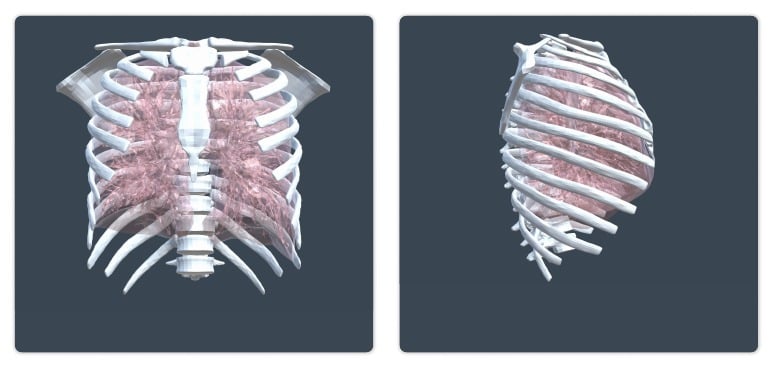
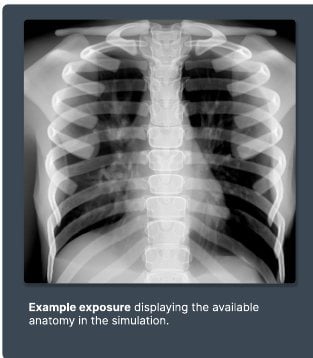
| What anatomy is included? | Thoracic vertebrae, scapulae, clavicles, ribs 1-10, sternum, upper lumbar spine, and lower cervical spine. |
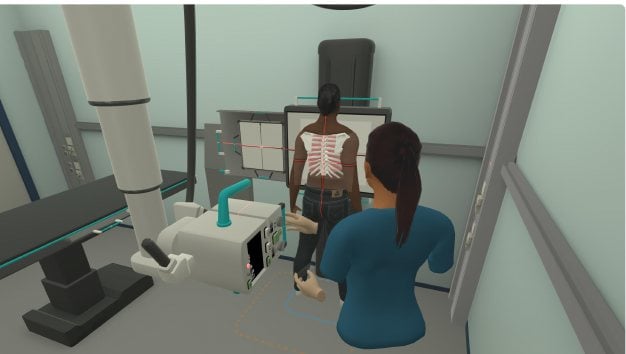
| What setup is used? | Wall bucky workflow. |
| What movement is included? | The rib phantom can be picked up and repositioned, but it does not have joint mobility. |
| What bone variations exist? | Healthy bone version. |
| Known limitation | Lung inspiration/expiration is not simulated, and rib trabecular bone detail is limited. |
Visual examples
- Simulator setup
- Example exposure

Imaging capabilities
| Capability | Details |
|---|---|
| Radiographic tube | Full range of motion, including vertical, horizontal, tilt, and rotation. The cassette can be rotated, and collimation size is adjustable. |
| Detector methods | The detector is set up for use with wall bucky. |
| Confirmed projections | Confirmed examples include AP, PA, AP unilateral, posterior axillary, and anterior axillary views. They do not define the full limit of what can be attempted. Other projections may be possible when the simulated setup supports them. |
Anatomy and movement
| Area | Details |
|---|---|
| Included anatomy | Thoracic vertebrae, scapulae, clavicles, ribs 1-10 bilateral, sternum, upper lumbar spine, and lower cervical spine. |
| Joint mobility | The rib phantom does not feature joint mobility, but it can be freely picked up and repositioned as needed. |
Bone variations
- Healthy bone version