Quick reference

QuestionWhat to expect
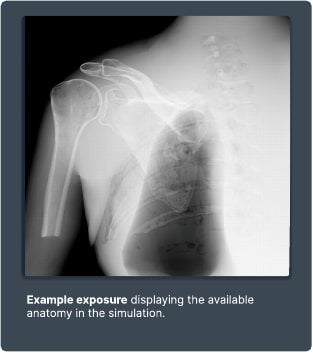
Which projections are confirmed?AP abducted, PA tangential, and apical shoulder views.
Can users try other projections?Yes. These are confirmed examples. Other projections may be possible when the simulated setup supports them.
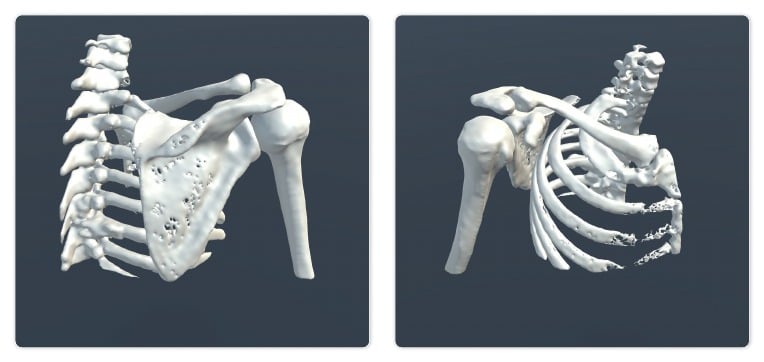
What anatomy is included?Humerus, scapula, clavicle, partial ribs 1-6, upper thoracic spine, and lower cervical spine.
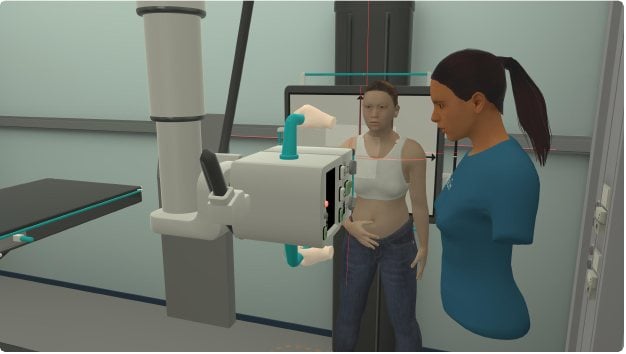
What setup is used?Wall bucky workflow with tube lock and detent support.
What movement is included?Patient axial rotation, anteroposterior adjustment, mediolateral adjustment, and shoulder internal/external rotation.
What bone variations exist?Healthy bone version and proximal humerus fracture variation.
Known limitationActive scapular movement through arm extension or flexion is not included.

Projection expectations

The projections listed on this page are confirmed examples for this simulation module. They do not define the full limit of what can be attempted. The simulator creates an image from the selected anatomy, patient position, joint movement, detector setup, tube position, collimation, and exposure settings, so other projections may be possible when the setup supports them.

Visual examples

Simulator setup preview

Imaging capabilities

CapabilityDetails
Radiographic tubeFull range of motion, including vertical, horizontal, tilt, and rotation. The cassette can be rotated, and collimation size is adjustable.
Detector methodsThe tube locks and detents to the wall bucky, enabling standard bucky tray operation.
Confirmed projectionsConfirmed examples include AP abducted, PA tangential, and apical views. They do not define the full limit of what can be attempted. Other projections may be possible when the simulated setup supports them.

Anatomy and movement

AreaDetails
Included anatomyPrimary bones: humerus, scapula, clavicle. Adjacent structures: ribs 1-6 partial, upper thoracic spine, and lower cervical spine.
Joint mobilityPatient axial rotation, anteroposterior adjustment, and mediolateral adjustment. Shoulder internal and external rotation.

Bone variations

  • Healthy bone version
  • Pathological version featuring a proximal humerus fracture

Known limitations

The patient can rotate the shoulder joint, but arm movement that would reposition the scapula backward or forward is not yet supported. Standard internal and external rotation is simulated, but active scapular motion through arm extension or flexion is not included in this version.