Quick reference
| Question | What to expect |
|---|---|
| Which projections are confirmed? | AP, oblique, and lateral foot views. |
| Can users try other projections? | Yes. These are confirmed examples. Other projections may be possible when the simulated setup supports them. |
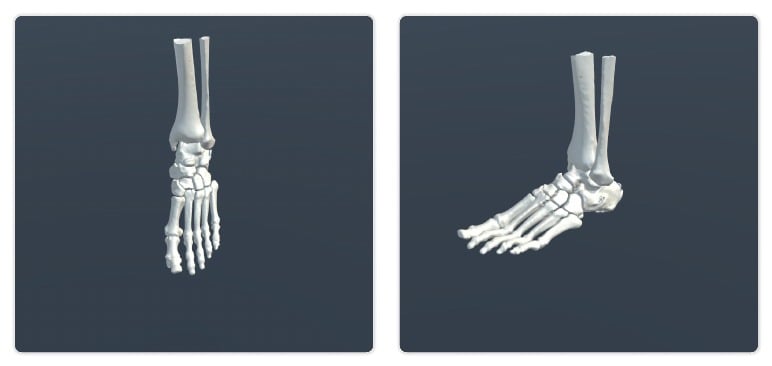
| What anatomy is included? | Tibia, fibula, tarsal bones, metatarsal bones, and phalanges. |
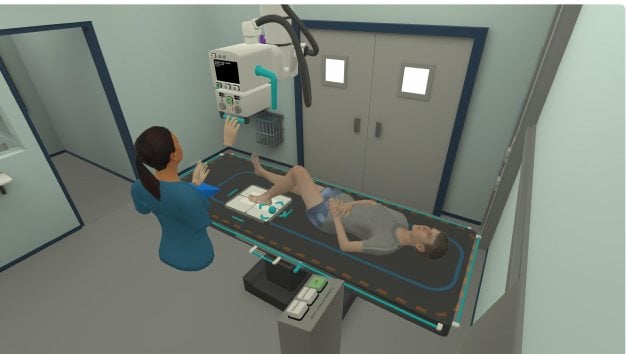
| What setup is used? | Free-plating workflow with the patient recumbent on the table. |
| What movement is included? | Foot plantarflexion/dorsiflexion for lateral body position, hip internal/external rotation for lateral body position, and patient craniocaudal and mediolateral adjustment. |
| What bone variations exist? | Healthy bone version and 5th metatarsal avulsion fracture variation. |
| Known limitation | No known limitations for this simulation as of v1.9.0. |
Visual examples
- Simulator setup
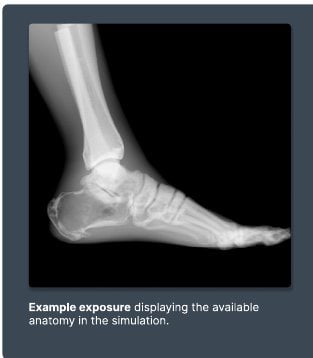
- Example exposure

Imaging capabilities
| Capability | Details |
|---|---|
| Radiographic tube | Full range of motion, including vertical, horizontal, tilt, and rotation. The cassette can be rotated, and collimation size is adjustable. |
| Detector methods | The detector is set up for free plating because the patient is recumbent on the table. |
| Confirmed projections | Confirmed examples include AP, oblique, and lateral views. They do not define the full limit of what can be attempted. Other projections may be possible when the simulated setup supports them. |
Anatomy and movement
| Area | Details |
|---|---|
| Included anatomy | Tibia, fibula, tarsal bones, metatarsal bones, and phalanges. |
| Joint mobility | Foot plantarflexion and dorsiflexion for lateral body position. Hip internal and external rotation for lateral body position. Patient craniocaudal and mediolateral adjustment. |
Bone variations
- Healthy bone version
- Pathological version featuring a 5th metatarsal avulsion fracture